Shakespeare wrote that “All the world’s a stage . . .” And that couldn’t be more true for neurodivergent individuals who so rarely get to retreat to the green room and escape the glare of the spotlight or the scrutiny of an audience.
“Masking” is one of the most prominent issues that come up in discussions within neurodivergent communities. I’d like to take a closer look at it here and consider a different perspective.
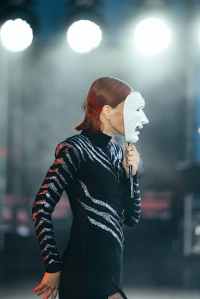
Photo by Konstantin Mishchenko on Pexels.com
You see, I’m not entirely sold on the term “masking” because something about it seems static and physical to me. If you wear a mask as part of a Halloween or Mardi Gras costume, all you need to do is put on that mask, then forget about it, resting assured that your identity is concealed. You go about being who you are knowing that the outside world can’t see your face. Furthermore, if it accidentally falls off, or if you remove it to get fresh air, no one seems to mind.
But that’s certainly not how “masking” feels for a neurodivergent individual.
I think we can all agree that “masking” is a process by which a neurodivergent person (perhaps with autism, ADHD, etc.; I’m trying to be as broad and inclusive as possible) actively—though perhaps unconsciously—hides their neurodivergent characteristics and attempts to strategically pass as a neurotypical person. There are many understandable reasons why someone would do this, including to fit in in an environment such as work or at a party where neurodivergent behaviors would be unwelcome or would attract undesired attention. One example would be sitting on your hands to prevent yourself from automatically stimming, or perhaps to consciously bring emotional inflection into your speech that you’re not naturally feeling, or perhaps to force eye contact that doesn’t feel comfortable or natural to you. There are really countless ways, though, that someone might mask.
We call these strategic behaviors “masking” but I prefer to think of them as “strategic neurotypical performance.” It’s not at all like putting a mask on, leaving it on, and feeling that your true identity is safely withheld.
Rather, masking behaviors are part of an active, exhausting, endless process of self-discipline, self-control, and self-monitoring. It requires endless reflection and consistent assessment: “Now what do I do?” “Was that weird?” “Am I making enough eye contact?” “Is my tone of voice appropriate?” “How is my volume?” “Have people discovered that I’m weird yet?” “What was that look for?” “She thinks I’m weird.” “I totally botched that conversation, didn’t I?” “Are we shaking hands here? When I’m introduced do I reach my hand out? What if he doesn’t take it? Covid, you know!” “What do I do next?” “When do I get to speak?” “Is that a lull in the conversation I can take advantage of?” “Am I acting enough like everyone else?” “Better watch them closer to make sure.”
You see, masking isn’t passive like putting on a mask. It is an active and constant performance that employs both our conscious and unconscious mental processes.
You see, masking isn’t passive like putting on a mask. It is an active and constant performance that employs both our conscious and unconscious mental processes.
It is a performance on a stage, just like any other. It is an intentional acting “as if” for the purposes of rendering a convincing display. It is the “becoming” of a character other than ourselves.
Like that given by professional actors on stage, a masking performance requires a “getting into character.” It requires a suspension of one’s self-image and self-concept in order to temporarily assume another. It requires reflection on what one’s desired effects are that we are seeking to enact upon an audience. And a desperate hope that we are successful, because much more is at stake than mere applause.
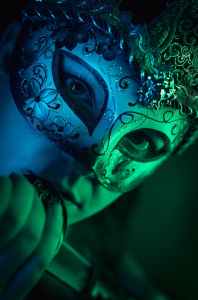
Photo by Chris F on Pexels.com
But unlike a professional actor’s work, masking isn’t done as an artistic craft or as the fulfillment of a talent (though it certainly takes a kind of talent!). Rather, it is an adaptive survival mechanism to facilitate passage through the world. And often, neurodivergent individuals don’t have a choice.
Masking is a chore. It’s work. And, especially when done 24/7, it depletes one’s internal resources and disorients any sense of stable identity. In many cases, the masking individual never leaves the stage, never comes out of character, and never allows themselves to feel the natural peace of simply “being oneself” without effort, without constant self-critique, and without shame.
Here are some questions I would love for you to consider in the comments:
- Do you think of masking as a kind of essential, never-ending performance?
- What are some of the ways that you mask?
- Like an artform, have you developed techniques?
- Have you ever been too exhausted or confused to continue masking and faced negative consequences?
Please share your thoughts! I would love to hear from you!
Your friend!
Jesse 🙂
 The Power of Performance