It was indeed a tremendous privilege to spend an afternoon leading a workshop for social workers at Binghamton University just last week. I was, of course, very excited but also a bit nervous because I was really hoping that I had something valuable to offer them. What seemed to make a significant impact in the room, and which several of the social workers said they were going to try in their work, was the Five Question Acceptance Exercise.
One of the clinicians—a therapist—even said that she would like to use it in sessions with her clients. Indeed, I could have received no higher compliment than that!
Because this exercise was so well-received, I decided I’d like to share it with the world. First, I’ll share the five questions and then I’ll offer a bit of an explanation.
Here are the questions to ask yourself or to pose to someone else if you are helping them, such as in a therapeutic or clinical context:
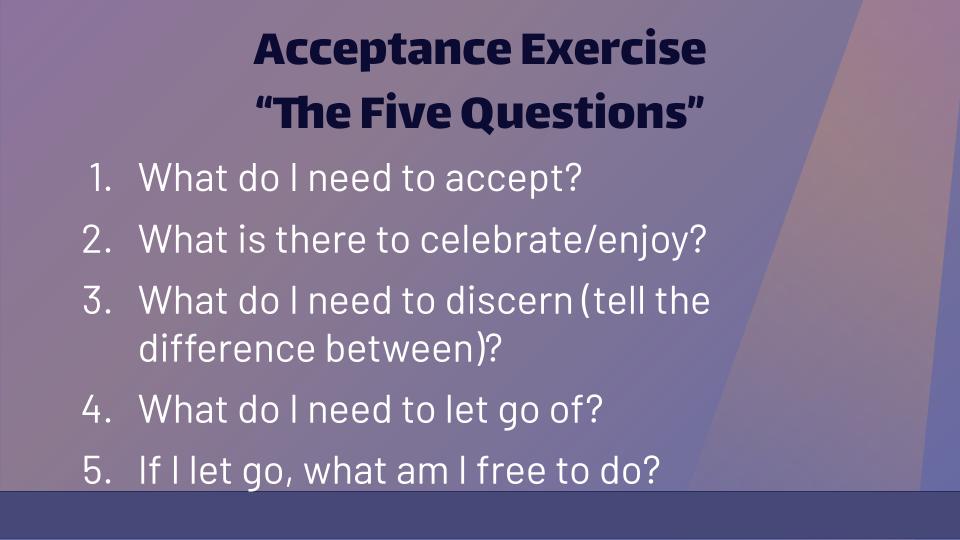
- What do I need to accept?
- What is there to celebrate/enjoy?
- What do I need to discern (tell the difference between)?
- What do I need to let go of?
- If I let go, what am I free to do?
In what situations is this exercise useful?
Anytime that you are facing a challenging situation or you are finding yourself with feelings that are overwhelming, difficult, or otherwise holding you back from something, this set of questions can help. I like to use it in situations that bring the three “un’s”: the uncomfortable, the unfamiliar, and the uncertain.
When we are facing these three “un’s,” this series of questions opens our minds to thinking about what we’re facing in new ways. And it also helps to sort out reality from our own perceptions that might be getting in the way. That’s why I call it an acceptance exercise; it enables us to come to terms with what is actually happening, which may or may not be as bad or as hopeless as our perceptions make it seem.
How do I go about doing this exercise?
I strongly recommend using the five questions as journal prompts. Ask each question individually and then start writing freely. Write down what comes to mind without worrying about if you are doing it “right” or “correctly.” Even if you aren’t’ quite sure what the question is asking (#3 is the one I get the most questions about), just start with the answer prompt and keep putting words down.
This exercise invites insights that come in the form of sentences that you didn’t expect to write. Sometimes people try this exercise and say “Whoa, I don’t know where that came from.” It’s almost as if the thoughts came from elsewhere. Great! Those are often the most transformative thoughts!
It’s important to be patient with yourself. Take your time. Allow the question to sit open and keep letting answers come to you. You may come up with a long list of ideas for each question. That’s fine! No limits! The more you let your mind run free as you consider each question, the deeper your thinking will begin to go.
When I do this exercise for myself, it’s often not the first answer that comes to mind which ends up being the most powerful. Sometimes it is, but more often than not, if I linger on the question, more and more interesting thoughts come up. And then you can really get somewhere!
Let me explain each of the questions one at a time:
- What do I need to accept?
I need to accept that . . .
This question dives right into it. Here is where we are being asked to make peace with reality. What is real? What cannot be changed? What do I need to begin believing even if it’s difficult?
The answers to this question can be both positive and negative. For example, you may need to come to terms with the fact that you have suffered an irretrievable loss. Or, maybe you need to come to terms with success. Those who deal with impostor syndrome often need to come to terms with the reality of their own accomplishments and the likelihood of more.
Regardless, you have the answers inside of you. You know what is real and what you may be resisting. This question helps us to lay out the real right in front of us. There’s no hiding from it now.
- What is there to celebrate/enjoy?
There is _____ to celebrate because . . .
I can enjoy . . .
(or however else the first sentence naturally comes to you)
This question is a bit jarring as we move from the realities that we need to accept in the previous question to a more positive and optimistic question here. That leap is intentional and helps unlock interesting insights.
What is there to celebrate in a situation that is uncomfortable, unfamiliar, and uncertain? How can I enjoy a situation in which I find myself struggling? I can hear your objections and resistance, but there is always something positive at work.
Coming from a very different angle, this question asks you to come face-to-face with positive realities. If, for example, you are going through a difficult period as you are working on a project or building a business, this question offers you a moment to consider how fortunate you are. How cool is it that you have a business to worry about? Isn’t it inspiring to think that you are growing through these challenges? This question may also allow you to notice the positive resources and influences that are available to you. Do you have people helping you? Are your talents being put to the test? How exciting!
Growth is always something to celebrate. You can at least count on that as you begin to answer this question. But don’t stop there. Isn’t there something to enjoy?
This can be a challenging question but it offers us a chance to place our situation into perspective, our challenges into proportion, and further asks us to come to terms with the reality in front of us. Perhaps the world is not ending for us after all.
- What do I need to discern (tell the difference between)?
I need to tell the difference between . . .
This is the question that people sometimes find the most confusing. But it’s also a critical question right in the middle of this process. Start with the template I just provided: “I need to tell the difference between . . .” and keep going from there. You don’t need to worry if your answer is “correct.”
When we are in the midst of a difficult time, we often lump things together that perhaps need to be seen and considered separately. I made an unintentional but profound discovery as I was doing this exercise and came to this question. I was writing about my fears about a big upcoming event at which I would be speaking. In answering this question, I found myself writing: “I need to tell the difference between valid fears about things that are likely to happen and anxiety that is simply not productive.” That helped me further place the situation and my response to it into a useful perspective.
This is a particularly powerful question after we’ve considered the positive aspects of #2. Answering the question about celebration and enjoyment first gets our brains warmed up to thinking about the situation differently. Questions 2 and 3 both challenge our human tendency toward catastrophic thinking.
Here’s another example of what can come up as you answer this question: I have seen people write “I need to tell the difference between what I can and can’t control.” I think that is such a powerful and transformative distinction to begin to make.
An alternative form of this question—only if it is helpful for you—is this: “Just because ____ doesn’t mean _____. “ For example: “Just because in the past I experienced this negative outcome doesn’t mean that I will this time,” or “Just because so-and-so didn’t think so doesn’t mean that my contribution isn’t valid.” In each of these cases, we are making useful discernments: this is not that.
Either form that you choose, this question invites us to reconsider our situation and open up our thoughts to explore more productive ways of seeing.
- What do I need to let go of?
I need to let go of . . .
For some reason, in ways I haven’t yet completely figured out, questions 2 and 3 prepare us to answer this one. For example, if you wrote “I need to tell the difference between what I can control and what I can’t” for #3, then the answer to #4 is relatively easy: “I need to let go of trying to control things that I can’t control.”
For myself, I wrote “I need to let go of the unproductive anxiety that has always gotten in my way.”
You could probably create a never-ending list in response to this question. Some brilliant answers I have heard include, “I need to let go of the need to please people,” and “I need to let go of blaming myself for the past,” and “I need to let go of something that simply isn’t working.”
While the answers may come to us more easily after answering questions 2 and 3, these are still insights that we would likely not have arrived at otherwise.
And finally . . .
- If I let go, what would I be free to do?
If I let go of _____, I would be free to . . .
What you’re imagining letting go of in this question is the answer to #4. Progressing from naming what you need to let go of to imagining what that would enable for you is empowering and liberating.
If I wrote about letting go of people-pleasing in question 4, now I can imagine what it would feel like if I did not care about pleasing people. I could write, “If I let go of people-pleasing, I would be free to enjoy my work without being so critical of myself.” Or “. . . I would be free to try new things without worrying about what people thought.”
What’s so wonderful about this question is that, not only is it inspiring to be imagining the positive possibilities that can emerge, but we also end up envisioning actions that we can take.
The answers to this question, we discover, are the things that we want. And things that are within the realm of possibility for us to have or to do.
So please do feel free to try out this exercise! You can do it for any situation that you’re facing and you can even do it multiple times, noticing the new ideas that come to you each time.
Please let me know how it goes! I would love to hear how it worked for you!
 The Power of Performance